Canterbury Emergency Management Home
  • Home ready
  • Work ready
  • Community ready
  • Home ready
  • Work ready
  • Community ready
  • Ready for anything
    • Evacuation
    • Disruption to electricity
    • Loss of communication
    • Disruption to water
    • Storing bottled water
    • Roadblocks
    • Waste
    • Damaged home
    • Care of pets
    • Wellbeing
  • Hazards
    • Your local hazards
    • Earthquakes
    • Tsunamis
    • Floods
    • Fires
    • Pandemics
    • Storms
    • Landslides
    • Infrastructure failures
  • Your district
    • Kaikōura
    • Hurunui
    • Waimakariri
    • Christchurch City
    • Selwyn
    • Ashburton
    • Timaru
    • Mackenzie
    • Waimate
  • Canterbury CDEM
    • About us
    • Governance, strategies and plans
    • Volunteering
    • R.A.T.S
    • Resources
    • News and media
    • Alerts
    • Contact us

Tsunamis

About tsunamis in Canterbury

Most tsunamis that arrive at our shores will not flood land but can still create strong, dangerous currents and surges in harbours, estuaries, river mouths and along beaches. Occasionally, larger tsunamis can flood coastal areas and threaten lives and property.

Canterbury tsunami evacuation zones

If you:

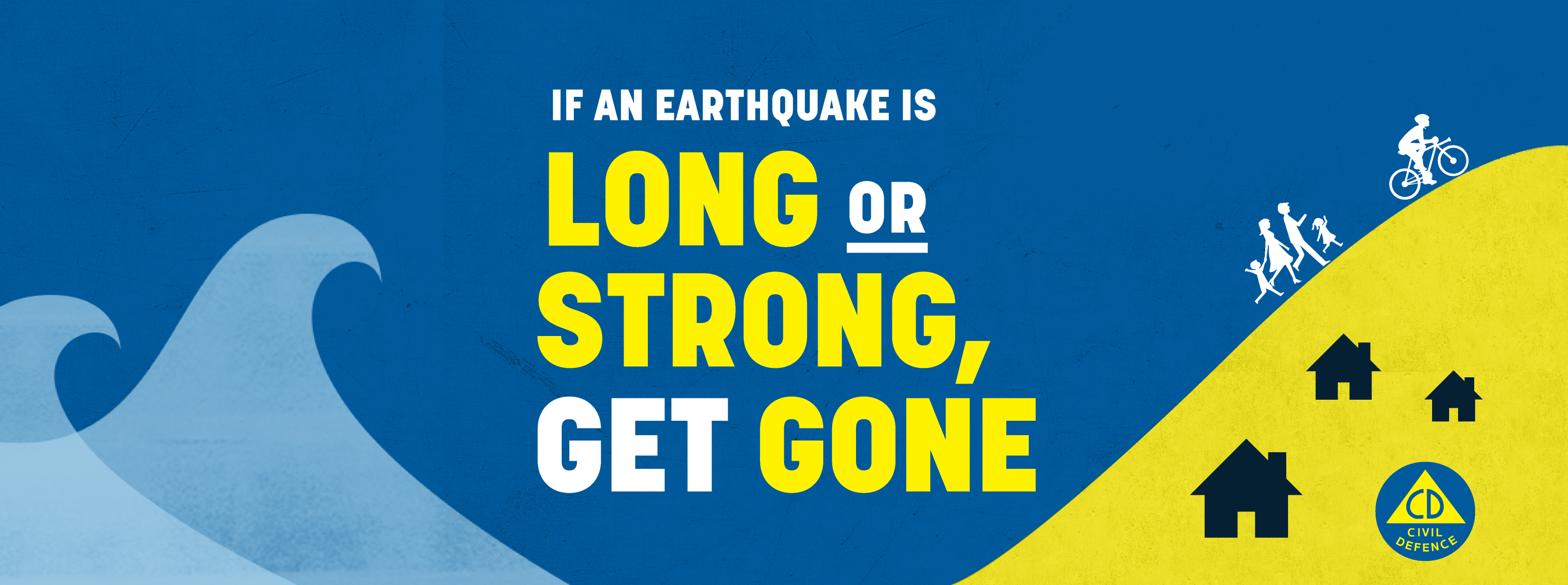
  • Feel an earthquake that shakes for longer than a minute, OR

  • Feel an earthquake that is so strong it is hard to stand up, OR

  • See the sea behaving strangely or hear the sea making loud, roaring noises

Then move inland or to higher ground, out of the blue tsunami evacuation zone, as soon as the shaking stops. Do not wait for an official warning, an emergency mobile alert on your phone, sirens, or for someone to tell you to leave. There may not be time for an official warning.

If you are not in the blue tsunami evacuation zone you do not need to evacuate after a long or strong earthquake. Evacuating if you don’t need to can cause more traffic jams, making it harder for those in the blue zone to get out.

You can find tsunami evacuation zones and what they mean for other parts of New Zealand on the National Tsunami Evacuation Zone Map. 
What you can do

611306959_1180080984295036_3338501400208141999_n.png
BEFORE - Top things you can do to prepare for a tsunami
  1. Think about where you will go if you live, work in or visit the blue tsunami evacuation zone - If you need to evacuate it is best to go to a friend or relative’s place outside the tsunami evacuation zone.

  2. Plan and practice your evacuation routes – Work out the best route for your household or workplace to get out of the tsunami evacuation zone. In urban areas, plan to walk or cycle to avoid getting stuck in traffic or stopped by damage to roads and bridges. Practice your route(s) with your household or workplace so that you are familiar with it before you need it – it is one of the best things you can do to be prepared for a tsunami evacuation. You can do this as part of the New Zealand ShakeOut and Tsunami Hīkoi. If you will need help to evacuate, talk to your support network beforehand to work out the best plan for you. If your children are at a school within the tsunami evacuation zone, ask the school what their evacuation plan is.

  3. Know what you need to take – You may be away from your house for many hours during a tsunami evacuation. Take essential items that you can easily find and carry, such as water, snacks, warm clothes, medication, supplies for babies and pets, and copies of important documents. Have a household or workplace discussion about what to take and where they are.

DURING - What to do during a tsunami evacuation

Natural warnings

Act on natural warnings. If a tsunami is coming from close to our shore, there will not be time for official warnings or emergency mobile alerts.

If you:

  • Feel an earthquake that shakes for longer than a minute, OR

  • Feel an earthquake that is so strong it is hard to stand up and things are being knocked over, OR

  • See the sea behaving strangely or hear the sea making loud, roaring noises

Then move inland or to higher ground, out of the blue tsunami evacuation zone, as soon as the shaking stops.

Do not wait for an official warning, an emergency mobile alert on your phone, sirens, or for someone to tell you to leave. There may not be time for an official warning.

In urban areas, plan to walk or cycle to avoid getting stuck in traffic or stopped by damage to roads and bridges. If you do drive, check if your neighbours need a lift.

Take your animals with you only if it will not delay you. Do not spend time looking for them and if you are not at home, do not return to get them.

Be mindful of earthquake damage such as fallen power lines or rockfalls in hilly areas.

If you are not in the blue tsunami evacuation zone you do not need to evacuate after a long or strong earthquake. Evacuating if you don’t need to can cause more traffic jams, making it harder for those in the blue zone to get out.

Official warnings

If a tsunami is coming from across the Pacific Ocean you will not feel the earthquake but there will be time to warn people. You may not need to evacuate the whole blue tsunami evacuation zone, you may just need to stay out of the sea, lagoons, estuaries, river mouths and off beaches to avoid dangerous currents and surges.

Tsunami advisories and warnings are issued by the National Emergency Management Agency and are published on www.civildefence.govt.nz, and broadcast on radio and television. An Emergency Mobile Alert may also be issued if land areas might be flooded.

Advisories and warnings, and advice on what areas to evacuate from or stay out of, will also be issued by your local city or district council through their websites, social media, tsunami sirens (if installed), Emergency Mobile Alerts, mobile text, loud hailer or other local arrangements.

How to find information in a tsunami evacuation

You can find information during a tsunami evacuation at:

  • Canterbury CDEM website

  • CDEM Canterbury Facebook

  • Your local city or district council website and social media sites

  • Radio New Zealand (101.7 FM / 675 AM in Christchurch, 101.3 FM in Ashburton, 101.1 FM / 918 AM in Timaru)

  • Newstalk ZB (100.1 FM / 1098 AM in Christchurch, 98.1 FM / 873 AM in Ashburton, 1152 AM in Timaru)

  • Hokonui FM in Mid Canterbury (92.5 FM, 96.5 FM)

  • Compass FM in North Canterbury (104.9 FM, 103.7 FM)

  • Brian FM (100.3 FM in Kaikōura, 105.3 FM in North Canterbury, 100.5 in Christchurch, 99.7 FM in Ashburton, 93.9 FM in Timaru)

AFTER - What to do when the waves have stopped

Stay out of the blue tsunami evacuation zone, or out of the water, until Civil Defence Emergency Management tells you it is safe to return. Tsunami activity can continue for many hours and the first wave may not be the largest. There may be debris in the water for many days or weeks after a tsunami.

If there was an earthquake, expect aftershocks. Aftershocks may generate another tsunami so be prepared to evacuate again.

Stay away from damaged areas. You might hamper rescue operations, cause further damage, or put yourself at risk.

Where our tsunamis come from 

Tsunamis are several long, powerful waves caused by a sudden movement of the sea (or lake) floor, or by something falling into the water. Most tsunamis are caused by large underwater earthquakes, but they can also be caused by volcanic eruptions or landslides under or into the water.

Canterbury’s coastline is exposed to tsunamis created both close to our shores as well as across the Pacific Ocean. Our biggest tsunami threats are large earthquakes on the Hikurangi and Kermadec subduction zones off the coast of the North Island, on the Puysegur subduction zone south of Fiordland, or off the coasts of Central or South America. Where a tsunami comes from determines how much warning time is available.

You can find out more about Canterbury’s tsunami hazard, including tsunami modelling and reports, on the Environment Canterbury website.

More about our blue tsunami evacuation zone

The blue tsunami evacuation zone replaced Canterbury’s previous red, orange and yellow tsunami evacuation zones in October 2026. This change was part of a national move to one tsunami evacuation zone to make it simpler and easier for people to know what to do after a long or strong earthquake, or in an official tsunami warning.

The blue tsunami evacuation zone is based on modelled flooding from ‘worst case’ tsunamis from several different locations, both close to our shores and across the Pacific Ocean. You can see the modelled tsunami flooding in our Canterbury Tsunami Model Results webapp. The evacuation zone covers small tsunamis that may not flood much, if any, land as well as rare, large tsunamis that could flood a lot of land.

In drawing the evacuation zone we also consider:

  • areas that might not be flooded but could be cut off or isolated by debris-laden tsunami water,

  • how easy the zone is to communicate – we will often move the zone boundary slightly inland to run along a road or other easily identifiable landmark,

  • the risks of evacuating too many people, such as traffic jams and accidents and delays for people closer to the coast,

  • the location of parks, schools and aged care facilities.

Tsunami wave in Christchurch

Tsunamis are not like regular waves. Just check out this video of one of the 2010 Chile tsunami waves coming into the Avon Heathcote Estuary (Ihutai) – it doesn’t look that high, but it packs a punch.

How ready are you?

Home ready
Work ready
Community ready

Tsunami research

  • All research
  • Tsunami science
  • Tsunami evacuation zones
  • Evacuation behaviour and modelling
  • Community participation
  • Building and infrastructure impact

Other hazards

  • Earthquakes
  • Floods
  • Pandemics
  • Storms
  • Fires
  • Landslides
  • Infrastructure failures

Find out more

  • Environment Canterbury tsunami information
  • GeoNet - tsunami monitoring
  • GNS Science tsunami information
  • Pacific Tsunami Warning Center
  • New Zealand tsunami database
  • Paleotsunami database
  • Get Ready tsunami preparedness information
  • NEMA Tsunami public education resources
  • NEMA national tsunami evacuation zones
  • NEMA Tsunami monitoring and detection network

Canterbury Maps

Tsunami evacuation zones

Visit website

Get ready

  • Home ready
  • Work ready
  • Community ready
  • Ready for anything

Your district

  • Kaikōura
  • Hurunui
  • Waimakariri
  • Christchurch city
  • Selwyn
  • Ashburton
  • Timaru
  • Mackenzie
  • Waimate

Canterbury CDEM

  • About us
  • Governance, strategies and plans
  • Volunteering
  • R.A.T.S
  • Resources
  • News and media
  • Alerts
  • Contact us

Contact Info

  • 03 366 2359

Accessibility
Copyright
Privacy
Civil defence emergency management group © 2026 All Rights Reserved
shielded